Quick answer
Open competitor product listings (Etsy, Amazon, Shopify), use the Bulk Image Downloader extension to save all product photos, organize by competitor/category, and analyze side-by-side. Understand how competitors present products.
If you sell physical products, understanding how competitors photograph, position, and price similar items is essential. Downloading their product images in bulk lets you analyze presentation strategy, packaging approach, and market positioning without tedious manual work.
Why product photo analysis matters
A competitive product analysis answers:
- Do high-priced products have better product photography? Is a $100 item photographed from more angles than a $20 item?
- What lighting and background do top sellers use? White background vs. lifestyle staging? Studio lighting or natural light?
- Which camera angles appear most often? Flat lay, 45-degree, detail shot, lifestyle context?
- How do color variants get shown? Separate photos per color, or swatches on one photo?
- What is the median photo count per listing? Do average sellers use 5 photos or 15?
Downloading all product images from 10 competitors and organizing them gives you this insight in a few hours. Doing it manually takes weeks.
The workflow: download, organize, analyze
- Identify 5-10 competitors. Find sellers in your category on Amazon, Etsy, Shopify, or niche marketplaces.
- Open each competitor's top 3-5 products in new tabs. Scroll each product page fully to load all photos.
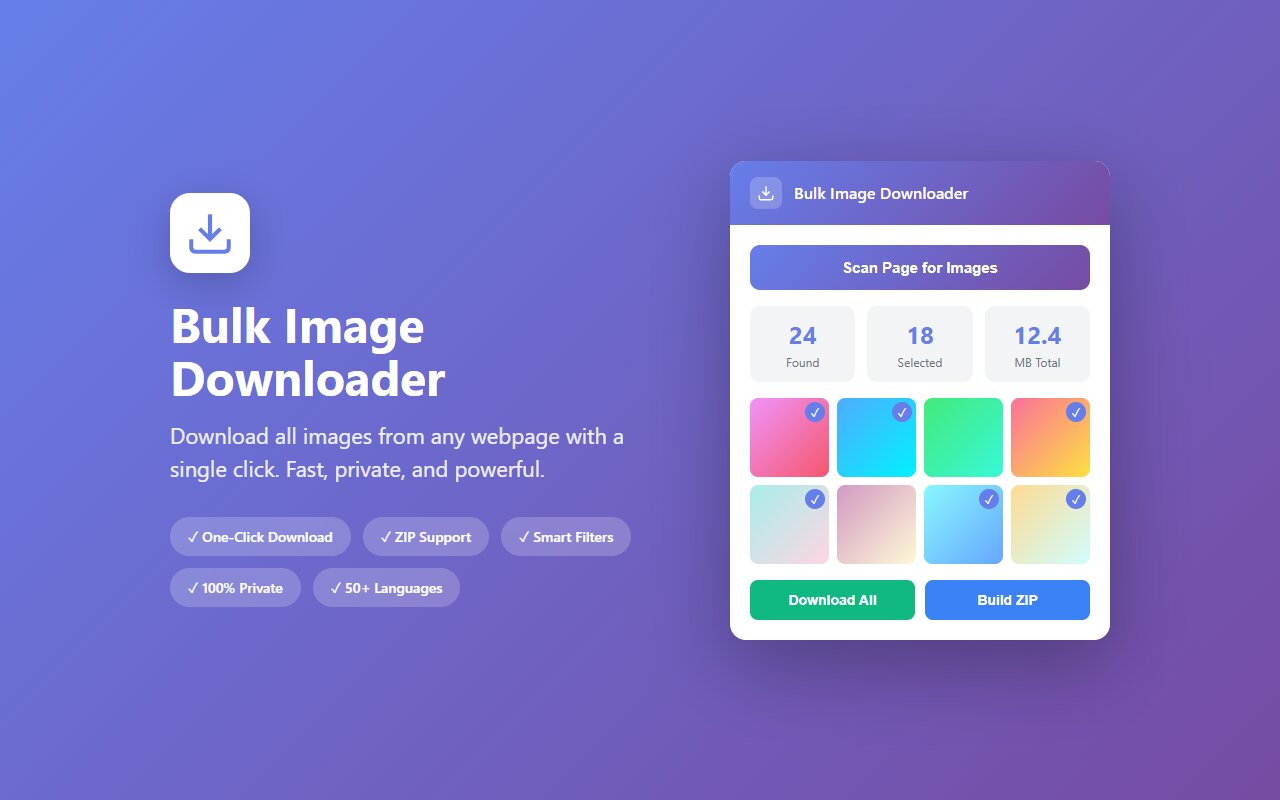
- Run Bulk Image Downloader on each tab. Download each competitor's product photos as a ZIP.
- Organize locally. Create subfolders: Competitor A, Competitor B, etc. Within each, subfolders for each product.
- Compare and document. In a spreadsheet, record: competitor name, product name, photo count, primary angles used, background style, average file size (proxy for resolution).
- Draw conclusions. What patterns emerge? Do high-priced sellers use lifestyle photos? Do all competitors avoid certain angles?
What to analyze
Once you have all the images organized, look for patterns:
- Photo count and pricing. Does $50 product have 8 photos but $20 product only has 5?
- Angle consistency. Do all sellers show front, back, and detail shot in that order?
- Lifestyle vs. flat-lay ratio. How many images are product-alone vs. product-in-use?
- Resolution and clarity. Are images crisp (likely high-res photography) or blurry (phone camera)?
- Color consistency. If selling apparel, how do they represent available colors?
- Packaging and unboxing. Do premium sellers show packaging? Unboxing shots?
Build a simple spreadsheet: Competitor | Price | Photo Count | Primary Angles | Lighting Style | Notes. Within an hour, patterns emerge.
Legal and ethical boundaries
Downloading product photos for competitive research is standard business practice.
- Analyzing is fine. Download and study competitors' photography style, angles, and presentation.
- Reference is fine. Use competitor photos as reference for your own shoot. Understand their lighting setup and angles.
- Republishing is NOT fine. Do not use competitor photos on your own site or in ads. Photograph your own products or hire a photographer.
- ML training is NOT fine. Do not scrape thousands of images for training machine learning models. This violates most e-commerce platforms' terms.
The rule: use competitor images to inform your own work, not to copy or republish.
Platform-specific tips
- Amazon: Click each variant (color, size) before downloading. Each variant has unique photos.
- Etsy: Scroll to load lifestyle photos and A+ content. Not all images appear above the fold.
- Shopify: Check "Size Guide" and "Details" tabs. Product images might be split across multiple sections.
- Niche marketplaces: Some indie sites load images slowly. Scroll extra slowly and wait for renders.
At-a-glance comparison
| Tool | Batch download | Lazy-load handling | Legal risk | Effort |
|---|---|---|---|---|
| Bulk Image Downloader | Yes | Yes (if scrolled) | Low (personal use) | Low |
| Manual right-click | No | No | Low | Very high |
| wget / curl | Yes | No | Low | Medium |
| Selenium bot (automated) | Yes | Yes | High (violates ToS) | High |
| right-click + spreadsheet | No | No | Low | Very high |